






























The Handheld Ultrasound Scanners Market is undergoing rapid transformation, driven by innovation in medical imaging, rising demand for point-of-care diagnostics, and the adoption of artificial intelligence (AI) technologies. Portable and easy-to-use handheld ultrasound devices are reshaping healthcare delivery, enabling faster diagnostics in hospitals, clinics, rural areas, and even home care settings. With a projected strong market expansion, key trends are emerging that highlight growth potential, technology breakthroughs, and shifting regional dynamics.
1. Market Growth Overview
The global handheld ultrasound scanners market has been expanding steadily in recent years. Between 2019 and 2023, the market showed a strong growth trajectory, with consistent adoption across healthcare systems worldwide. Continued innovation and healthcare digitization are expected to sustain this growth through the next decade.
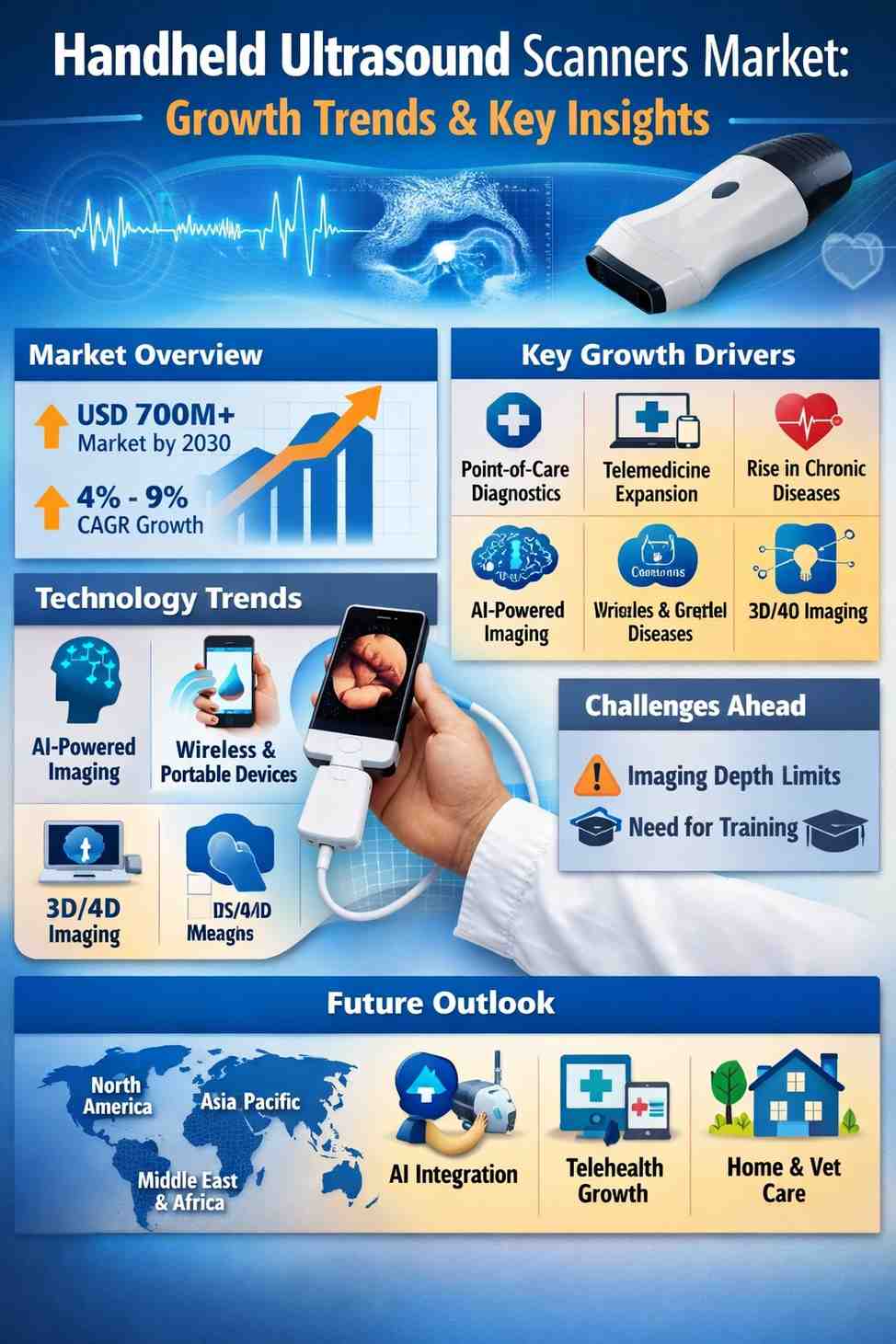
Industry analysts project that by the early 2030s the handheld ultrasound scanners segment will reach significant revenue milestones, with estimates ranging toward well over USD 700–1,100+ million depending on report forecasting models. This reflects a compound annual growth rate (CAGR) that could vary between roughly 4% to over 9% through the next decade.
2. Key Market Drivers
1. Rising Demand for Point-of-Care Diagnostics
Healthcare systems are increasingly focused on delivering rapid, accurate diagnostic imaging at the patient’s side, especially in emergency rooms, intensive care units, and outpatient clinics. Handheld ultrasound scanners help clinicians make faster decisions without relying on bulky traditional machines — boosting efficiency and patient outcomes.
2. Expansion of Telemedicine and Remote Healthcare
With telehealth services becoming more common — especially after the COVID-19 pandemic — handheld devices enable clinicians to conduct imaging in remote areas and share results with specialists instantly. Their integration into telemedicine workflows has become a distinguishing trend in enhancing access to care.
3. Growth in Chronic Diseases and Preventive Care
The prevalence of chronic conditions such as cardiovascular diseases, diabetes, and respiratory disorders has escalated globally. These conditions require frequent imaging and monitoring, which handheld ultrasound devices conveniently support at the point of care.
4. AI and Connectivity Integration
Modern handheld ultrasound scanners increasingly incorporate AI-driven software and mobile connectivity, making imaging faster, more accurate, and easier to interpret. AI can assist by highlighting areas of interest, auto-measuring anatomical structures, and suggesting diagnostic insights — even for users with limited ultrasound experience.
3. Technology Trends Shaping the Market
1. AI-Driven Diagnostics
Artificial intelligence isn’t just a buzzword — it’s now fundamental in handheld ultrasound devices. AI algorithms help in automatic image enhancement, real-time diagnostics, and improved interpretation accuracy. This trend is making handheld scanners more valuable not just to specialists but also to general practitioners and rural healthcare providers.
2. Wireless and Cloud-Based Platforms
Manufacturers are embedding wireless connectivity, enabling data transmission via Bluetooth or Wi-Fi to smartphones, tablets, or cloud systems. This simplifies image sharing, allows faster collaboration, and supports integration with electronic health records (EHRs).
3. Miniaturization & Portability
Advances in hardware have led to devices that are lighter, more ergonomic, and easier to carry, even weighing under 500 g. Improved battery life and compact design make these devices practical for emergency teams, mobile health missions, field hospitals, and veterinary care.
4. 3D and 4D Imaging
While 2D handheld scanners remain popular, 3D/4D imaging technology is gaining prominence for its ability to provide more detailed spatial views — particularly useful in cardiovascular and obstetric applications.
4. Regional Market Insights
1. North America
North America holds a significant share of the handheld ultrasound market due to advanced healthcare infrastructure, strong telehealth adoption, and reimbursement policies that support portable diagnostics.
2. Europe
Europe’s healthcare agencies focus on digital health integration, enabling a shift toward mobile diagnostics. Countries like Germany, the UK, and France account for a large portion of the regional market.
3. Asia-Pacific
The Asia-Pacific region is among the fastest growing markets. Healthcare digitalization efforts and government policies to improve rural access to diagnostics are driving adoption, especially in China, Japan, and India.
4. Middle East & Africa
This region is experiencing increased handheld scanner usage in urban hospitals and rural clinics alike due to mobile health initiatives and partnerships aimed at expanding healthcare access.
5. Applications Across Healthcare
Handheld ultrasound scanners are no longer limited to traditional radiology settings. They are now widely used in:
Emergency medicine & trauma care
Obstetrics and gynecology
Cardiology and vascular imaging
Primary care and outpatient clinics
Veterinary medicine
Sports medicine and field diagnostics
The versatility of these devices is one of their greatest strengths, helping clinicians detect, monitor, and evaluate medical conditions quickly and efficiently.
6. Market Challenges and Restraints
While the market shows strength, there are some limitations:
1. Image Depth & Power Constraints
Smaller handheld devices may have limited power and imaging depth compared to larger systems. For certain clinical uses requiring deep tissue views, traditional equipment may still be preferred.
2.Training Requirements
Although AI helps, interpreting ultrasound images accurately still requires professional training. Adoption in some regions may be slowed until comprehensive training programs are more widely available.
7. Future Outlook
The future of the handheld ultrasound scanners market looks promising:
1. Continuous AI enhancement
2. Broader integration with telehealth
3. Expansion into non-traditional settings (home care, sports, veterinary)
4. Increased accessibility in rural and underserved regions
By combining portability with digital intelligence, handheld ultrasound technology is set to play a central role in the future of medical imaging and diagnostic care.
Conclusion
The handheld ultrasound scanners market is entering a new era of growth and innovation. With increasing demand for fast diagnostic tools, widespread AI integration, and a shift toward point-of-care and remote healthcare services, these devices are poised for continued expansion. As technology evolves, handheld ultrasound machines are likely to become even more integral in improving patient outcomes, widening access to care, and transforming how clinicians approach diagnostic imaging.









Discussion about this post