
























You can build chest muscle without equipment by doing push-up variations two or three times a week and making them steadily harder over time. The key is progressive overload: once an exercise feels easy, add reps, slow the movement down, or switch to a tougher version such as decline push-ups. Combine that with enough rest, protein and sleep, and bodyweight training can build real strength and muscle at home.
Below is a clear 4-week beginner plan, plus the principles behind it so you can keep progressing after the first month. For individual exercise ideas, see our guide to no-equipment chest workouts at home.
How Muscles Grow Without Weights
Muscles adapt when you challenge them a little more than they are used to, then give them time to recover. Weights are one way to add challenge, but not the only one. With bodyweight training you can increase difficulty by:
- Changing leverage: moving from wall to incline to floor to decline push-ups.
- Adding volume: more reps or more sets.
- Slowing down: taking three or four seconds to lower yourself.
- Adding pauses: holding the bottom position for one or two seconds.
- Shortening rest: resting a little less between sets once you are used to the workload.
Research on push-up variations supports the leverage approach: a biomechanics study found push-ups with the feet elevated produced the highest forces, while push-ups with the hands elevated or from the knees produced the lowest. That gives you a built-in ladder from easy to hard.
How Often Should You Train?
The American College of Sports Medicine (ACSM) recommends training each major muscle group two or three days a week, waiting at least 48 hours between resistance sessions, and doing 2–4 sets of 8–12 repetitions to improve strength. The NHS similarly advises strengthening all major muscle groups on at least two days a week. The plan below follows these guidelines with three sessions a week, for example Monday, Wednesday and Friday.
Before You Start: Find Your Level
Do as many good-form push-ups as you can from the floor:
- 0–4 reps: start with incline push-ups (hands on a counter or sturdy table).
- 5–12 reps: start with knee push-ups and some full push-ups.
- 13+ reps: follow the plan using full and decline push-ups.
Write the number down. You will test again at the end of week 4.
The 4-Week Beginner Chest Plan
Warm up for 5 minutes before each session with arm circles, shoulder rolls, marching on the spot and 10 easy wall push-ups. Rest 60–90 seconds between sets. “Main push-up” means the version that matches your level above.
Week 1: Learn the movement
| Exercise | Sets × reps | Notes |
|---|---|---|
| Main push-up | 3 × 8 | Normal speed, perfect form |
| Incline push-up | 2 × 10 | Hands on a counter or chair |
| Isometric palm press | 3 × 10 seconds | Squeeze palms together at chest height |
Week 2: Add volume
| Exercise | Sets × reps | Notes |
|---|---|---|
| Main push-up | 3 × 10 | Same version as week 1 |
| Wide-grip push-up (same level) | 2 × 8 | Hands a little wider than usual |
| Incline push-up | 2 × 12 | Lower surface if possible |
| Isometric palm press | 3 × 15 seconds |
Week 3: Slow it down
| Exercise | Sets × reps | Notes |
|---|---|---|
| Main push-up, 3-second lowering | 4 × 8 | Count “1-2-3” on the way down |
| Wide-grip push-up | 3 × 8 | |
| Pike push-up or incline push-up | 2 × 8 | Pike push-ups work the front shoulders |
| Isometric palm press | 3 × 20 seconds |
Week 4: Level up
| Exercise | Sets × reps | Notes |
|---|---|---|
| Next-level push-up | 3 × 6–8 | Incline → knee → full → decline |
| Main push-up, 1-second pause at bottom | 3 × 8–10 | |
| Wide-grip push-up | 2 × 10 | |
| Isometric palm press | 3 × 20 seconds |
At the end of week 4, retest your maximum push-ups. If you improved, repeat the 4-week cycle using the next push-up level as your “main” exercise. To focus more on the upper chest, add the routine from our upper chest workout at home.
Form Checklist for Every Push-Up
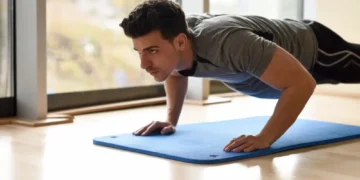
- Hands slightly wider than your shoulders, fingers pointing forward.
- Body in a straight line from head to heels (or head to knees).
- Core and glutes tight; no sagging hips.
- Elbows about 45 degrees from your body, not flared straight out.
- Lower under control until your chest is close to the surface.
- Breathe in on the way down, out on the way up.
Nutrition and Recovery
Training gives the signal for growth; food and rest provide the building blocks. Include a source of protein, such as eggs, dairy, pulses, fish, poultry, tofu or lean meat, at each meal, eat enough overall to fuel your training, and aim for good-quality sleep. Learn more in our guides on how to gain muscle weight and the importance of good nutrition.
Common Mistakes That Slow Progress
- Doing the same workout forever: if nothing gets harder, your body has no reason to adapt.
- Training chest every day: muscles need recovery time; follow the 48-hour guideline.
- Half reps: partial movements build less strength than full, controlled ones.
- Ignoring the back: balance pushing with back exercises such as supermans to support posture.
- Skipping the warm-up: cold joints are more prone to strain.
Safety Notes
Stop if you feel sharp pain in your wrists, elbows or shoulders. If you have a joint injury, high blood pressure, a heart condition or another long-term health problem, or are pregnant, check with a doctor or physiotherapist before starting a new strength programme.
The Bottom Line
Building chest muscle without equipment comes down to three things: choose the right push-up level, make it gradually harder, and recover well. Follow the 4-week plan three times a week, retest your push-ups, and repeat at the next level. Consistency over months, not perfection in a single workout, is what delivers results.
Frequently Asked Questions
Can you build chest muscle with just push-ups?
Yes, especially as a beginner. Using harder variations, slower reps and more sets over time keeps challenging the chest muscles so they continue to adapt.
How many push-ups a day to build chest?
There is no magic daily number. A better approach is 2–4 sets of 8–12 challenging reps, two or three times a week, with rest days in between, as the ACSM recommends.
How long does it take to build chest muscle at home?
Strength often improves within a few weeks. Visible muscle growth usually takes longer and depends on training consistency, nutrition, sleep and genetics.
Should I train chest every day?
No. Allow at least 48 hours between hard sessions for the same muscles so they can recover and grow stronger.
What can I use instead of a bench for decline push-ups?
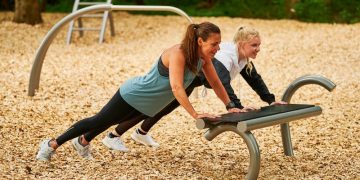
A sturdy step, stair, low coffee table, sofa or chair that will not slide works well. Start low and raise your feet as you get stronger.
Sources
- Medical News Today: ACSM issues new recommendations on quantity and quality of exercise (2011)
- NHS: Physical activity guidelines for adults aged 19 to 64
- Wurm B, Ebben W, et al. Kinetic analysis of several variations of push-ups. ISBS Conference Proceedings, 2010
- Healthline: Decline Push-Up
This article is for general information only. Speak to a doctor or physiotherapist before starting a new exercise programme if you have an injury or health condition.