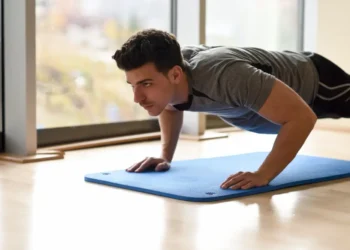
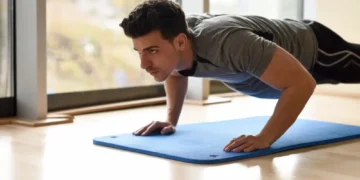























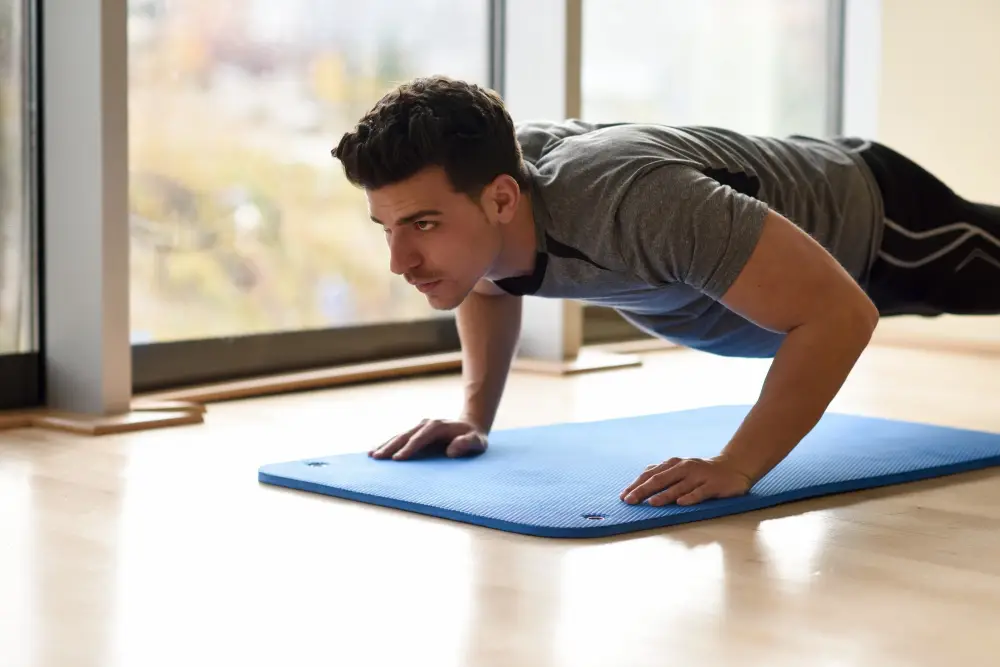
The best upper chest workout at home without equipment is built around the decline push-up: a push-up with your feet raised on a step, sofa or chair. Raising your feet shifts more of the work to your upper chest and the front of your shoulders, and it makes the push-up harder than the standard version. Add a few supporting moves, train two or three times a week, and progress slowly, and you can build a stronger upper chest using only your body weight.
This guide covers the exercises, how to do them with good form, a ready-made workout for beginners and more advanced exercisers, and how to make progress without weights. For a full-chest routine, see our main guide: No Equipment Chest Workouts at Home.
Why Train the Upper Chest?
Your main chest muscle, the pectoralis major, has an upper portion that attaches near your collarbone and a larger lower portion. Standard push-ups work the whole muscle, but angling your body so you press slightly upwards, relative to your torso, places more emphasis on the upper fibres. Healthline notes that decline push-ups primarily work the upper chest and front shoulders, while the core, glutes and thighs work to keep your body straight.
A stronger upper chest also helps with everyday pushing and lifting tasks, such as putting things on high shelves or pushing a heavy door.
6 Upper Chest Exercises Without Equipment
1. Decline push-up (main exercise)
This is your key upper chest move. Research presented at the International Conference on Biomechanics in Sports found that push-ups with the feet elevated produced higher ground reaction forces (meaning you push more of your body weight) than the other push-up variations tested.
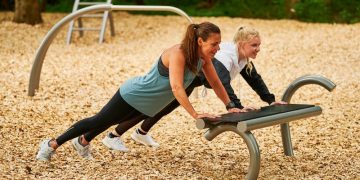
- Kneel with your back to a sturdy step, bench, sofa or chair and place your feet on top.
- Put your hands on the floor slightly wider than your shoulders, with your shoulders over your wrists.
- Brace your core, squeeze your glutes and keep your body in a straight line.
- Bend your elbows to about 45 degrees from your body and lower your chest towards the floor.
- Push back up to the start.
Healthline suggests 2 to 4 sets of 8 to 20 repetitions. Start with a low surface, such as the bottom stair, and raise your feet higher as you get stronger.
2. Standard push-up
If decline push-ups are too hard at first, master the standard push-up with good form. It builds the strength you need for harder variations and still works the whole chest.
3. Incline push-up (beginner option)
Place your hands on a kitchen counter, table edge or sturdy chair with your feet on the floor. With your hands higher than your feet, you lift less of your body weight, making this a good starting point for complete beginners. Lower the surface over time until you can do push-ups on the floor.
4. Wide-grip decline push-up
Set your hands a little wider than in the regular decline push-up. Healthline notes that a wider grip puts more emphasis on the chest and shoulders, while a narrow grip shifts work to the triceps. Do not go so wide that your shoulders feel strained.
5. Pike push-up
Start in a downward-dog position with your hips high. Bend your elbows to lower the top of your head towards the floor between your hands, then press back up. This mainly targets the front shoulders, which work alongside the upper chest during pressing, so it is a useful accessory exercise.
6. Isometric palm press
Sit or stand tall and press your palms together in front of your chest, elbows out, as hard as you comfortably can. Hold for 10–20 seconds, keep breathing, and repeat 3 times. Pressing with your hands slightly higher, around chin level, keeps the focus near the upper chest. It is a gentle finisher and a good option on days you want less joint stress.
Upper Chest Workout Plans
Warm up first for 5 minutes with arm circles, shoulder rolls, marching on the spot and a few easy incline push-ups. Rest about 60–90 seconds between sets.
Beginner workout (2–3 times a week)
| Exercise | Sets | Reps |
|---|---|---|
| Incline push-up | 3 | 8–12 |
| Standard push-up (or from knees) | 2 | As many as you can with good form |
| Decline push-up, feet on the bottom stair | 2 | 5–8 |
| Isometric palm press | 3 | 15-second holds |
Intermediate and advanced workout (2–3 times a week)
| Exercise | Sets | Reps |
|---|---|---|
| Decline push-up, feet on a chair or sofa | 4 | 10–20 |
| Wide-grip decline push-up | 3 | 8–15 |
| Pike push-up | 3 | 6–12 |
| Standard push-up (slow, 3 seconds down) | 2 | To near failure |
| Isometric palm press | 3 | 20-second holds |
Leave at least one rest day between chest sessions so your muscles can recover.
How to Keep Progressing Without Weights
Muscles grow stronger when you gradually ask more of them. Without dumbbells, you can do this by:
- Raising your feet higher in decline push-ups.
- Adding reps or sets week by week.
- Slowing down the lowering phase to three or four seconds.
- Pausing at the bottom for one or two seconds.
- Trying harder variations such as one-leg decline push-ups or wearing a loaded backpack, as Healthline suggests.
Common Mistakes to Avoid
- Sagging or arching your back: tighten your core and glutes to keep a straight line from head to heels.
- Flaring your elbows: keep them at about 45 degrees to protect your shoulders.
- Looking up: keep your neck in line with your spine by looking slightly ahead of your hands.
- Using an unstable surface: make sure the chair or step will not slide.
- Rushing: controlled reps are more effective than fast, sloppy ones.
Stop if you feel pain in your wrists, elbows or shoulders, and speak to a doctor or physiotherapist if it continues.
Do Not Forget Food and Recovery
Training is only part of the picture. Eating enough protein and overall calories, getting good sleep and staying consistent all support muscle growth. For broader tips, read our guides on how to gain muscle weight and why a balanced diet is important.
The Bottom Line
You do not need a gym to train your upper chest. Decline push-ups are the foundation, supported by standard, incline, wide-grip and pike push-ups plus isometric presses. Train two or three times a week, keep your form strict, and make the exercises gradually harder to keep seeing progress.
Frequently Asked Questions
Do decline or incline push-ups work the upper chest?
Decline push-ups, with your feet raised, target the upper chest. Incline push-ups, with your hands raised, are easier and better suited to beginners building strength.
How many push-ups should I do for upper chest?
A common starting point is 2 to 4 sets of 8 to 20 decline push-ups, two or three times a week. Choose a number you can do with good form and increase it gradually.
Can I build upper chest muscle without equipment?
Yes. Bodyweight exercises can build strength and muscle, especially when you keep making them harder by raising your feet, adding reps or slowing the movement.
Are decline push-ups harder than regular push-ups?
Yes. With your feet elevated, you support more of your body weight with your arms, which makes each rep more demanding.
Is this workout suitable for women?
Yes. The exercises work the same way for everyone. Beginners of any gender can start with incline push-ups and progress at their own pace.
Sources
- Healthline: Decline Push-Up (medically reviewed)
- Wurm B, Ebben W, et al. Kinetic analysis of several variations of push-ups. ISBS Conference Proceedings, 2010
This article is for general information only. Speak to a doctor or physiotherapist before starting a new exercise programme if you have an injury or health condition.